Precarity and Critical Design
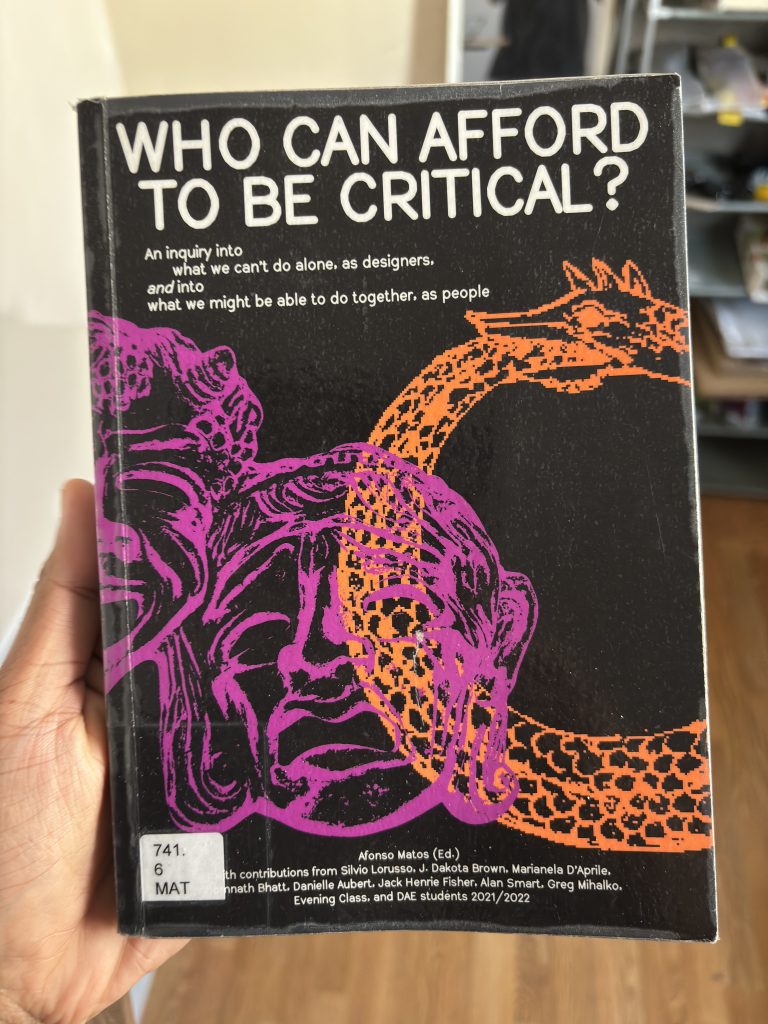
The cross-years studio on Industry and Precarity was an eye opener. I came across a publication by Afonso Matos, Who can afford to be critical. The recorded conversations and thoughts about critical design, graphic design and industry and precarity in the book, were similar to conversations I had with my peers a year back.
The author writes about the thoughts of precarity amongst students in courses of design and critical design and being in school which do inculcate practices that have the power to create change in social contexts, but the world outside the school does not understand this potential as much, resulting in students having to struggle harder to keep up with their practice and engage in impactful change as designers. Most of us will be a cog in the machine, at least for a while until we can ground ourselves and work on things that could be essential in empowering people. But I do believe the thinking matters. The thinking we develop in school is what we take away with us, and we can keep coming back to our own practice and do our parts juggling precarity and survival.
I like the arguments offered by the author where conversations about agency happen, suggesting that design itself has a lot of agency and power, however, designers have less agency than design itself. Someone speaking with the author asks how we can give more agency to the designers, involving designers in conversations that are impactful and important is needed for them to have an opinion in creating change, opinions that can actually create change.
Through this course, we aim to see design as a medium or a tool to critically challenge ideas and aim to create social change. But a lot of what we do often remains bound within the walls of our school. I think there needs to be exchange in the potential of critical design in the world outside school to ensure designers get to work with the practice and knowledge they develop in the school and they live a life of less precarity.

Leave a Reply