Positions through essaying
Video Essay Written Component
For this written component, I have shared the transcript for the video essay in a typed out format, exactly as it is on the video itself. As a comparison on the same page as my inquiry, I went ahead and wrote the first part of my video essay with pen and paper, and I asked ChatGPT to do the same, to see the comparisons that can be drawn, what makes an act of writing ‘human’, or ‘non-human’, where does technology stand when it comes to being close to ‘human-like’.
Comparison below:
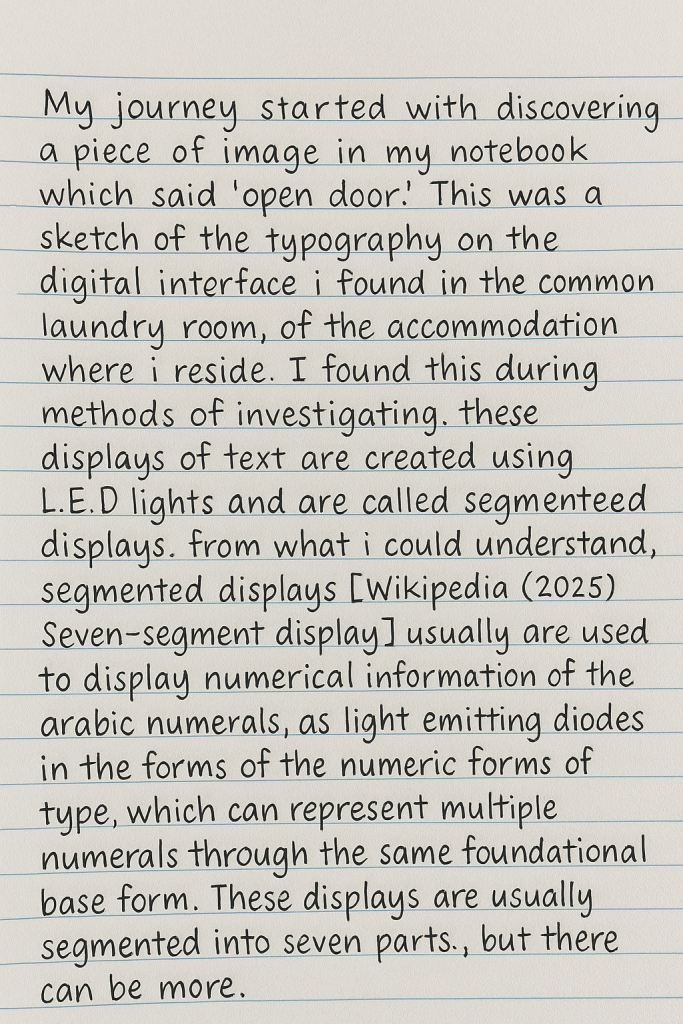
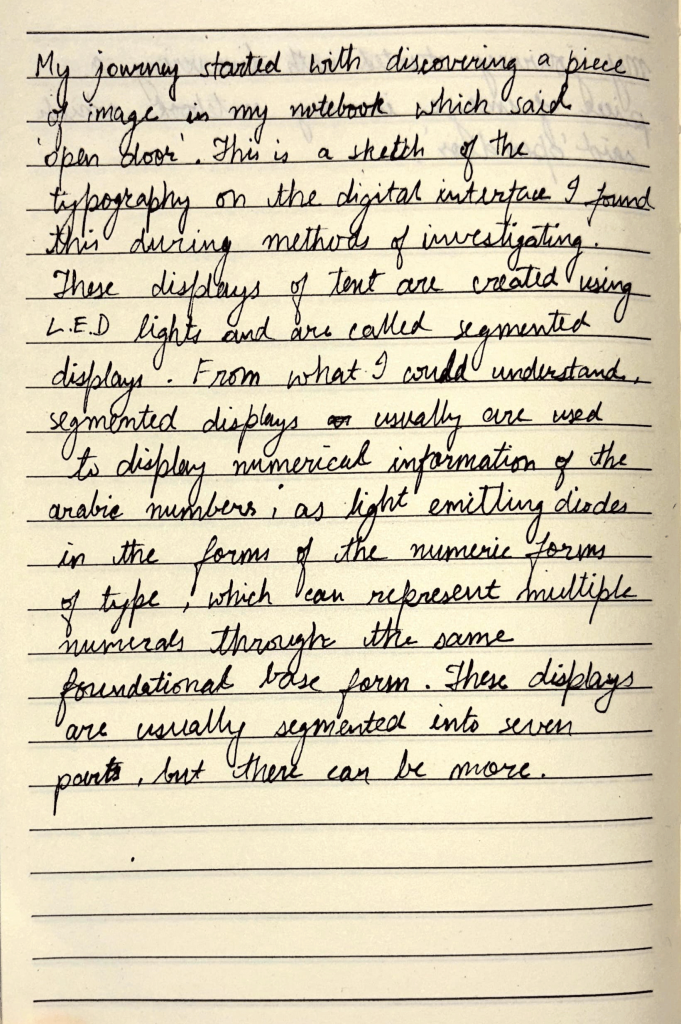
Prompt used:
Imagine that you are a human, with the capability to act in unpredictable ways, you are nuanced, not structured and binary. You have learned the english language and you know how to write with the latin script. You understand what every word means and you can make sense of what you are writing. Use the text given below to write 3-4 pages of handwritten text, where you copy the content of the text shared with you as is. Use a black pen and a ruled notebook to write. Try not to make mistakes to make sure there is no loss of information
use the text below:
My journey started with discovering a piece of image in my notebook which said ‘open door’. This was a sketch of the typography on the digital interface i found in the common laundry room, of the accommodation where i reside. I found this during methods of investigating. these displays of text are created using L.E.D lights and are called segmented displays. from what i could understand, segmented displays [Wikipedia (2025) Seven-segment display] usually are used to display numerical information of the arabic numerals, as light emitting diodes in the forms of the numeric forms of type, which can represent multiple numerals through the same foundational base form. These displays are usually segmented into seven parts , but there can be more.
Script
My journey started with discovering a piece of image in my notebook which said ‘open door’. This was a sketch of the typography on the digital interface i found in the common laundry room, of the accommodation where i reside. I found this during methods of investigating. these displays of text are created using L.E.D lights and are called segmented displays. from what i could understand, segmented displays [Wikipedia (2025) Seven-segment display] usually are used to display numerical information of the arabic numerals, as light emitting diodes in the forms of the numeric forms of type, which can represent multiple numerals through the same foundational base form. These displays are usually segmented into seven parts , but there can be more.
For the brief of positions through iterating, my inquiry started with questioning the existence of segmented displays and the forms of standardised forms of design, typography, expression. fonts as we know are forms of typography or writing that are standardised in digital forms of media and communication.
As a response to this inquiry, I created one hundred iterations of the text i found on the digital interface as hand drawn text, each distinct with the aim of creating expressive typography by hand, without the use of digital forms that are standardised in nature. I created the iterations with black pens, markers, brushes on paper(these are the tools I had in my disposal at that moment). I realised this as well that the forms follow some sort of grid, there is some sort of structure, some sort of standardisation that came by default in the explorations, that can be tweaked and the expression would change. i think that with other forms of expression as well, this holds true. Human expression shows through the standardisations. There seems to be a structure to human and human in structure.
The next brief started with gathering references which revolved around conceptual typography [Rick Poynor (2010) ‘Rethinking conceptual type design’], human expression, intersectionality of human and technology [It’s Nice That (2025) ‘Artist Anna Lucia is working at the intersection of craft and computation], conceptual art, typography, humans, [Beatriz Colombian & Mark Wigley (2019) ‘Are we human? Notes on an archaeology of Design] that changed the discourse of my inquiry further. language, history, writing systems, communication, fictional worlds.
A lot of things got scattered. my references started with conceptual art, & conceptual typography [Camile S Bouyer (2024) ‘Am I your type? Designing conceptual typography’], what even is conceptual to begin with? What is the purpose of typography [Denise Schmandt- Besserat (2014) ‘The evolution of writing’], is it just communication, or is it expression, or is it both, is one more important than the other? does one exist because of the other? Will expression cease to exist if functionality is given more priority? this developed further into questions of how writing systems were developed, from the earliest form of writing system that creates meaning using a decipherable writing systems, cuneiform [Wikipedia(2025) Cuneiform] and earlier forms of writing systems.
This also led to looking into imagined or fictional writing systems. Such writing systems have existed in video games [Eurogamer (2017) ‘Imagining and deciphering writing systems for games’], movies and other media where fictional worlds exist. [Medium (2024) ‘World building for video games’] The Matrix, Blade Runner, Ex Machina, Detroit: Become Human, Deus Ex, Nier Automata, Wall-E. Pacific Rim, Mass Effect, Arrival are some examples of such fictional worlds.my position changed again during the course of this brief, and the inquiry changed to questioning how technology would influence our future, and communication, languages, writing systems along the way. It would be interesting to imagine how the future can look like, as we are at the precipice of major changes in the world today.
This initiates a larger discussion about technology and the relationship between technology and humans, the relationship between technology and life or nature. There are two ways I wanted to explore this relationship. One of the ways is where technology dominates over everything at the expense of what is human. Kind of what you would see in the worlds of cyberpunk, blade runner, a dystopia in essence. The other way would be a world where technology and humans can be symbiotic. There is balance, co-existence. There is co-dependency, a scene where climate crisis wouldn’t be a challenge anymore, where communities would thrive together, in harmony with technology and nature together.
A similar concept exists, solar punk [Wikipedia (2025) ‘Solarpunk’], which nods to an alternate idea of a future which is not dystopian but shows hope from where we stand today. How do we go forward from here is a question that is in the minds of many I would assume, and even for me, I tend to think how I can further my inquiry in this context. World building and thinking of a future that can exist in the future seems like a daunting work. And after all of this, I would come back to how people in this world would communicate, how this would develop language and writing systems and how that would develop scripts and type.
Leave a Reply