Positions through contextualising
Bibliography
- Stuart Bertolotti Bailey (2007), ‘Towards a critical faculty’
“We no longer have any desire for design that is driven by need. Something less prestigious than a “designed” object can do the same thing for less money. The Porsche Cayenne brings you home, but any car will do the same thing, certainly less expensively and probably just as quickly. But who remembers the first book, the first table, the first house, the first airplane? All these inventions went through a prototype phase, to a more or less fully developed model, which subsequently became design. Invention and the design represent different stages of a technological development, but unfortunately, these concepts are being confused with one another.”
The quote above says that we no longer have desire for design that is necessity driven. The argument is that functionality overshadows aesthetics. I think it resonates greatly with my inquiry. Maybe we have become so fixated on efficiency and affordability that we have lost sight of artistry & expression in the process of design. The cost of standardisation is compromising the uniqueness of human identity. This standardisation of typography in the digital age where practicality often trumps unique expression, just as Bailey talks about invention and its relation to design, the forgettability of mundane objects, I wonder if our reliance on standardised digital typography is creating a homogenous visual landscape, sacrificing the potential for more expressive and individualised communication.
2. Michael Rock (1996), ‘Designer as Author’
Authorship may suggest new approaches to understanding design process in a profession traditionally associated more with the communication than the origination of messages. But theories of authorship may also serve as legitimising strategies, and authorial aspirations may actually end up reinforcing certain conservative notions of design production and subjectivity — ideas that run counter to recent critical attempts to overthrow the perception of design based on individual brilliance.
The paragraph mentioned above talks about design processes in a broader sense as being associated more with communication more than origination of message, or expression. In the context of human expression in this day and age, design processes/ tools are standardised elements. Typography in the digital age is standardised by fonts and layouts. Though designers can create meaning & expression even within these constraints through font choices, spacing, hierarchy, etc., This compels us to reconsider the nature of authorship and creativity in a digital world. This questions the role the author has in design, typography, expression in today’s world, in a world which is mechanised and automated in every facet.
3. Rick Poynor (2010) ‘Rethinking conceptual type design’
“In conceptual type, the underlying idea is the most important factor even at the expense of legibility.”
This specific statement stands out to me in the context of my inquiry. Through the iterations I produced during creating the iterations of the text :open door, I made letterforms and lockups that often looked illegible from a communicative point of view. When it comes to conceptual art, in this case, typography, the underlying idea or thought would carry more value than the communication aspect of it. Communication might not be the primary objective of the type or design, but maybe the intent, idea behind a given iteration can be the purpose of a given design or form. I think that this gives the designer an opportunity to explore the areas of abstraction and expression and not stay limited by the functionality of design.
4. Nejc Prah (2021) ‘Crack Up, Crack Down’
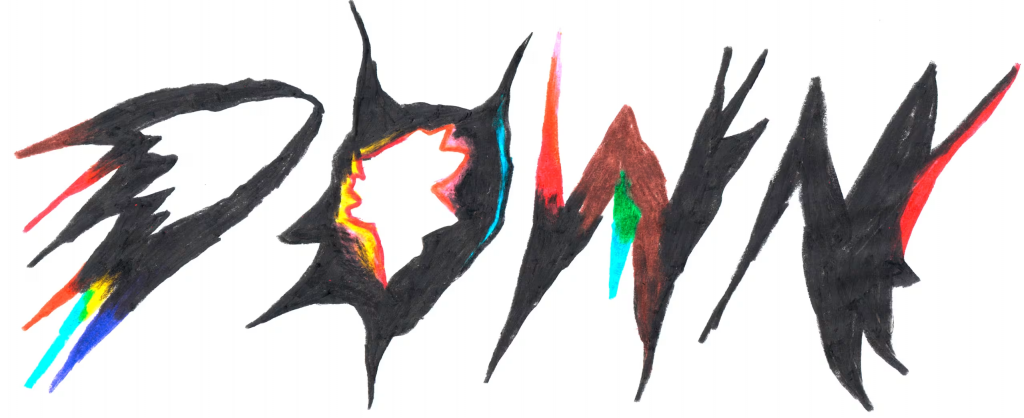
The selection behind this reference is in related to my method of iterations in the initial stages. I explored typography by drawing them on paper. Without any grids and compositions, I went ahead and drew letterforms with the same text repeatedly, using only a black coloured pen/ brush to create the type & letters. The iterations are about expressing the standardised segmented typography as seen on interfaces in different ways, but with a few constraints in the medium of expression. The iterations happened in the letterforms and arrangement of the type. The hand-drawn aspect of this reference is interesting, the forms are drawn in a free-form manner and not rigid by structure, although the letters are cohesive and belong together, I also like how different colours are used as accents within the forms in different areas.
5. Camile S Bouyer (2024) ‘Am I your type? Designing conceptual typography’
“Another approach is to explore concepts through the design of the type itself, breaking free from the traditional rules of typography and experimenting with new shapes and structures.”
By exploring typography in concepts through the design of the type itself, we can look at typography in a different light, not for serving the purpose of communication and within traditional structures and systems, the exploration of concepts can be about the type design itself. It can be about expression and idea behind the design that outweighs the functional and communication aspect of it. This helps us to escape from the mundane and functional aspect of typography. By focusing on experimenting with forms and design of the type itself, we connect more with the personal approach and visual expression of typography and design. This also creates space for more diversity and distinct identities for us as designers and human beings through our expression.
6. It’s Nice That (2025) ‘Artist Anna Lucia is working at the intersection of craft and computation’
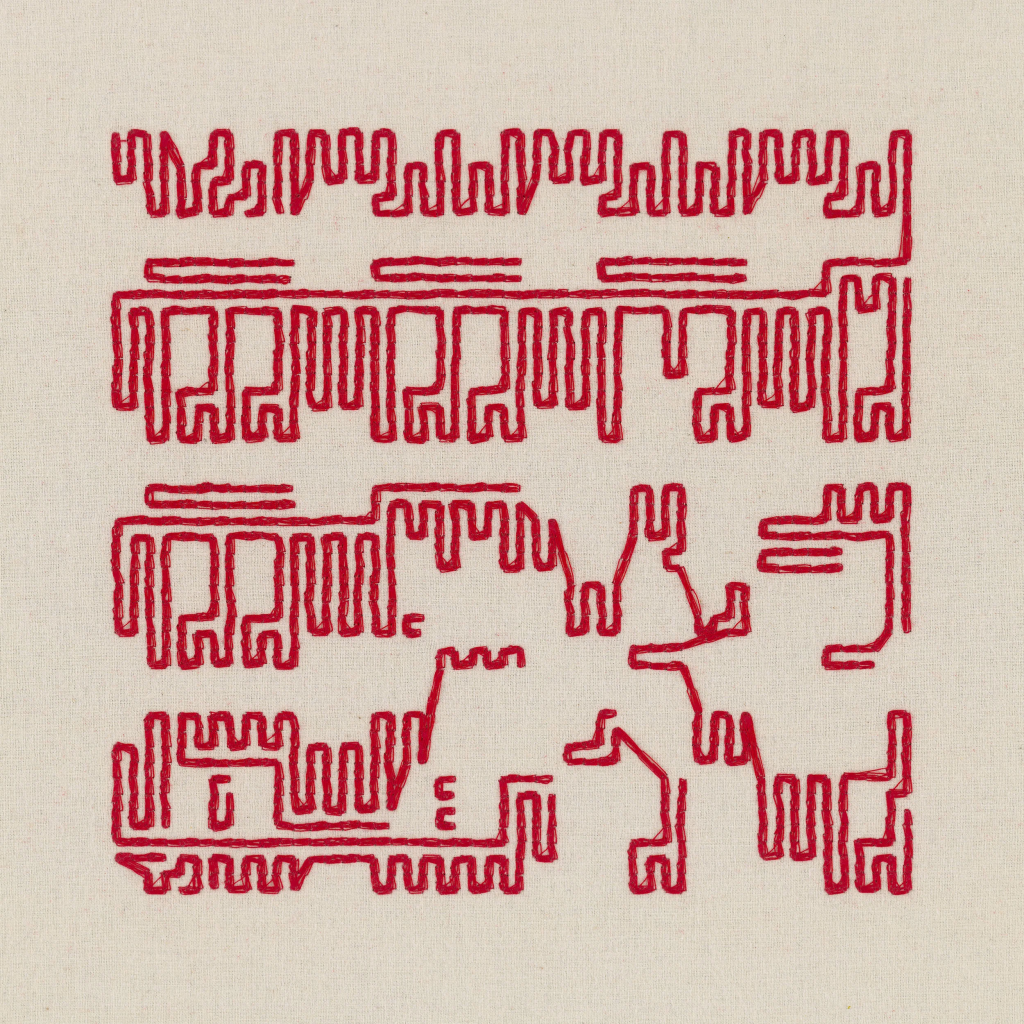
Anna Lucia works with the interaction of code and textiles. She says her work falls in the intersection of technology and craft. I can relate this to my inquiry on typography and human expression in the digital landscape in a similar way. I think the iterations I created starting with the typography from a digital interface and attempting to create variations of it by re-drawing it to create hand-drawn iterations of it was a way to explore the shapes, also creating distinct forms in expression through type design. Its not exactly the same, in her work, the overlap of technology, structure, systems and randomness is more balanced, perhaps that is a possible route for me to explore in my project.
7. Beatriz Colomina & Mark Wigley (2019) ‘Are we human? Notes on an archaeology of Design’
“The history of design is therefore a history of evolving conceptions of the human. To talk about design is to talk about the state of our species.”
The human and its design and everything that we have designed as humans is about our identity as humans. If we were to trace back the history of humankind through a lens of design and all things we have designed so far, it would be a representation of the history of us, of humankind itself. Anything designed, is a representation of whats human, inventions and technology as well, in ways, are part of whats human too, all of it is made, created by us. In a way, getting back to my inquiry, it would not be too wrong to say, that even with technology and standardisation of expressions, it is still human in a way, that is built by human, and it is used, tweaked and re-expressed in addition with the expression of the human using these tools to create or express.
8. Robin Kinross (2004) ‘Modernity after modernism’ Modern typography pp. 158-182
“Typefaces were now no longer tied to any particular typesetting or printing device. In all previous systems of mechanical composition of type, both metal and photographic, typefaces had been part of the composing system and had thus to be made or adapted by the particular machine manufacturer. But now the same data of description could drive any output device which had the software installed, and at any resolution. Typeface design changed fundamentally too. In the days of mechanical composition, designs were drawn on paper and then interpreted and adapted by company draftspeople, for photographic reproduciton and fitting into the metrics of a particular composing machine. But when font design software packages became commercially available, there was no longer any barrier between drawing and the final product. So the way was open to the individual designer to set up as his or her own typeface producer.”
Type design and production techniques for type have gone through several changes throughout the course of our time. The reference mentioned above talks about the period in history when ‘fonts’ were invented. It talks about a transitional phase, where how type was produced was also changing due to the advancement in technology in terms of computation and the growth of silicon valley companies. This in relation with my inquiry, speaks about the transformation of expression, in this case, typography, with a change in technology. I question the same for the upcoming future. How will communication, language, typography change with the ‘newer’ forms of technology, maybe we get to see more standardisation, maybe we get to see more expression, if technology is democratising art, how does that affect expression overall, will we see more unique expression, or will we see a variation of standardisations?
9. It’s Nice That (2024) ‘Type knitter Rüdiger Schlömer makes fonts for screens & jumpers’
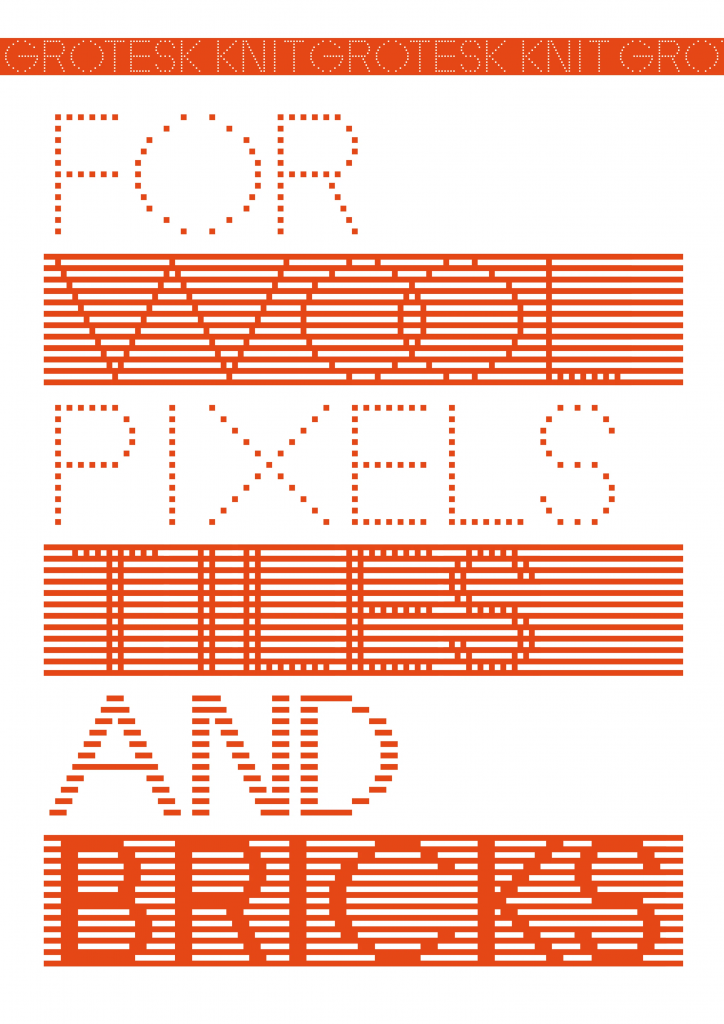
Rüdiger Schlömer’s work is a combination of physical and digital mediums. He works with type design and textiles, and translation of one to another. In the work referenced above, the forms are inspired by the forms seen on textiles and knitted material. The technique of knitting on textiles also direct the creation of the type-forms in this work. In a way, its a translation of the physical medium of knitting and textiles and the techniques used to create said forms of work into a digital medium of type-design and typographic expression. Coming to the inquiry of my brief, about the intersection of human and technology, his work pieces together a balance of the two entities in question, and, also creates a sort of dialogue between physical and digital forms of media. The aspect of translation of one form of media into another, something that looks like something else is of interest to me.
10. Denise Schmandt- Besserat (2014) ‘The evolution of writing’
“The evolution of writing from tokens to pictography, syllabary and alphabet illustrates the development of information processing to deal with larger amounts of data in ever greater abstraction.”
Then what is next? Through my inquiry, I wish to understand the nature of human expression over the years through the changes in technology and mechanical changes around us that affect our experience as humans. I wonder how things can change in the upcoming years. At this time in history, I think, we are again at a phase of transition, where we are undergoing major changes in technology. With the recent developments in technologies such as AI and automation, it is very unpredictable how things will look like in the future. This is both a question and something to think and ruminate about. With my inquiry, I reflect on the thought of how communication and language might look like in the future from the lens of design and typography. How will the functional aspect of typography and language, communication changes and how that affects how we communicate within communities and our species at large.
11. Eurogamer (2017) ‘Imagining and deciphering writing systems for games’
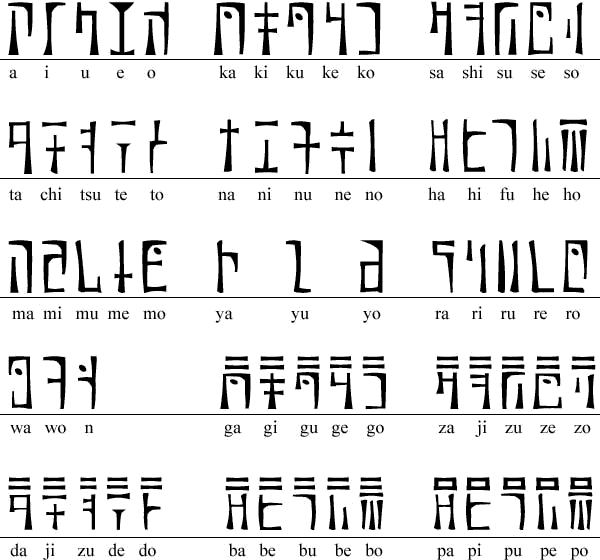
The reference above is a fictional writing system seen in the video-game: The legend of Zelda. This intrigues me a lot as this functions as a working language inside a game world, which takes inspiration from existing languages such as Japanese, but the forms are comparatively simpler in design. Each letterform is a syllable that is associated with a specific sound. If we break down the existence of written language, they are a representative of vocal languages, or sounds for most of us. Each syllable denotes a specific sound which can be used in combination, I would assume, to create sense and meaning that creates a believable world for the player. Through my research, I can iterate and imagine writing systems of the future and how they can be represented, that would stem from the development of communication and language itself. These forms are representative of the kind of world the players interact with. So if we are to imagine the world in the future based on current advancements, we would have to imagine a world, how it looks like, what are the people like, elements that make up the world, where, the language becomes a part that has evolved alongside the humans.
12. Kelly Bender ‘Worldbuilding Guide for Video Games’
“The fictional worlds of novels, films, and TV shows are designed to host the story—the fictional worlds of video games are designed to host the player.”
This is a great comparison between the three different kinds of media mentioned. Its not directly related to my inquiry, although, through these past weeks, I have come across world building as a way to think about an imagined future and imagined writing systems & typographic forms. Video game world have a different approach to world building, in a way that is often more interactive than just observatory. In certain games, such as No Man’s Sky, the language of the main story line is deciphered slowly as the player progresses through the game and it gradually starts making meaning, translating to English. It features its very own writing systems, one can also use a writing system to create a language that can be interactive, more than just as a visual or an element of the world to make it feel real, but also as a gameplay mechanic, and games certainly use this mechanic in more small-scale ways, in forms of puzzles or communication in storylines or quests. My point being that video game worlds often have to create more detail in their world building to make it more believable and ‘lived’ to the player, for the player to feel immersed and invested.
Critical Analyses
- It’s Nice That (2025) ‘Artist Anna Lucia is working at the intersection of craft and computation’
Anna Lucia is an artist working with textiles and code. Her work is a combination of physical and digital media. “My work is in the intersection of craft & computation”, says Anna in the referred article published by Itsnicethat. Her work shows structure and randomness within an underlying structure. She works in systems formed by stringent rules and simultaneously breaks them by introducing randomness in the system. As she mentions in the article, she creates her work through dialogue with the machine, a computer, in this case. The created algorithm decides the final outcome using randomness that is created through code. She creates the playground by deciding the boundaries for form and colour, and the computer creates based on the rules created by Anna.
This work shows a great balance between physical and digital media, where they work with each other in a complimentary way. In Anna’s work, human expression breaks through the structure and bounds of a digital tool. In her series of works titled ‘Oefenstof’, textiles become the physical medium where the artwork is executed based on the generations of the algorithm as created by Anna, which serves as the digital medium or tool. The visuals that appear on the artwork are created by generations from the algorithm. The artist sets the input for forms and colours and creates a controlled environment for the chaos to occur which the code creates using the inputs given.
In an interesting way to look at her work, I think I can say that in a way, the digital medium of algorithm almost expresses like a human, with the creation of ‘randomness’ in its way of expression, it creates a nuanced output, which is not predictable or direct, again, kind of human-like. The patterns are dictated by the inputs given by the human in this conversation, in a way, teaching the language the human speaks to the computer algorithm and letting the machine talk and express in its own way, while within a space contained by the human. So there is an exchange that happens in between the human and the machine in this process. The human and the machine both, take their respective roles in this exchange, but also, exchange their respective roles to take up each other’s. The machine thinks in nuances, creates patterns through code, almost like a human would, while the human takes the role of executing the pattern on the textile. With relation to my inquiry, her work showcases a great balance between human expression and use of digital media/ tools.
I seek to deeply understand the role digital tools such as ‘fonts’ play in the modern world and how that affects human identity and expression. We live in a world that is increasingly becoming more and more digital with technology in every area of our lives. Technology like AI will change the way design works and it will affect our expression and identity and experience as humans on this planet.
There are a lot of questions that rise in times like these. How do we navigate through changing times like these? How do we as humans define what is human? What are the ethics surrounding technology and its use in human expression in the future. Another example I can site from my references is the work of William Jacobson. His work explores the domain of text and language. His work is created by dialogue between him and his machine. The machine in this case, are tools of generation.
So, in conclusion, both of their work explore the intersectionality of digital tools/ medium/ technology and human expression and identity. They use existing and newer technologies in their work to express, while maintaining a balance between their ‘human side’ and the tools they use. In the case of Anna’s work, she uses the physical medium of textiles to create the final outcome based on the code she designed, generates. I wish to explore this balance and dialogue between my human self and generative forms of existing or nascent technology in developing my inquiry further.
2. Beatriz Colomina & Mark Wigley (2019) ‘Are we human? Notes on an archaeology of Design’
“To talk about design is to talk about the state of our species.” quoted from ‘Are we human? Notes on an archaeology of Design’, talks about our relation as humans with the concept of design, the designed and what it represents in terms of our species and our existence in the universe as humans.
What is human is us and everything that we see around us, that is ‘designed’ by us. As the book mentions in one of the spreads, if one was to travel from Mars towards the earth, how would they come across our species, how would they come across homo sapiens, would it be from the satellites in outer space or other space junk, it goes on to further describe other forms and human-made ‘designs’ that one might come across, from the internet, to cities, etc., that are suggestive of a first encounter with our species.
I would like to add that this goes to show that ‘design’ is in everything that is connected to our existence and is a medium of human forms of expression, even in terms of functionality and things in existence for the largely functional purposes are also a form of expression, and it is very much human, we are the ones who have created everything around us, from the clothes we wear, to houses, to the internet, to satellites and everything else on the planet.
The book goes further to talk about how humans are nuanced creatures, there is no clear definition of a human, there is no clear bounds or outlines within which a human can be contained, the lines are blurry and unclear.
The book is a physical form of media, although I consumed it from a digital ‘e-book’ version. The layout is very pleasing to the eye, not too cramped, with a slightly larger ‘font-size’ than the standard, or recommended size, and it also features pictures on some pages with texts on adjacent pages. There are spreads in between chapters which have a bright yellow background and smaller paragraphs in larger font sizes. There also, are image spreads with quotes on them. Overall, the editorial design of the book is very nuanced and flexible, and is a pleasant read.
The narrative of the book is very straightforward and informative as well. There is a clear direction that goes from paragraphs of information to smaller chunks of text that talk about something specific to very specific quotes, all with image clippings, full page images and full spreads of images stitched in between.
The book talks about our relation to design as humans ,which would also include graphic and communication design, which, along with other fields which are specifically known as fields of design, such as product, industrial, automotive, etc., as if there seems to be a hypothetical system of what can be and what cannot be called design, I think that this reading helps in understanding that design is everywhere around us, everything that is human and human-made is ‘designed’.
Sure, there are different levels of complexities in said ‘design’ and we might need specific ‘human-resources’ to create something nuanced. Design is more horizontal and can be called an umbrella term to contain every thing that is created or ‘designed’. Its not a judgement or critique of design or the designer itself, its more about what we call design in the current time in the world. This book offers a different outlook at our relationship with design as a species and looks at the aspect of being a human in social and historical contexts, even taking our existence in the cosmos as a context to talk about what is human.
Coming back to my inquiry, this reference is useful in getting an understanding of the landscape of design and human, which is a larger context to my research on our relationship as human and technology, which is also created by us, humans, I took away from the book ideas that humans and human-made are not separate entities, what we create and what we have created so far is representative of us, as humans, and is part of our identities just as much.
Leave a Reply